If you’ve tried this and still can’t sign in, contact your local office or email info@richardsonmediagroup.net.

The home equity alternative many homeowners still haven’t heard of

For years, homeowners who wanted to access their home value in cash had two main options: a home equity loan or a home equity line of credit (HELOC). Both of these options require that homeowners make monthly payments based on how much they used, however. A newer product, called a home equity investment (also known as a home equity agreement or home equity sharing), takes a different approach. Homeowners receive a lump sum from the home equity investment provider and make no monthly payments. In exchange, they agree to share a portion of the home’s future value.
No single equity option is right for everyone, and there are pros and cons to each. Hometap explains how a home equity investment stacks up next to a home equity line of credit in terms of process, cost and potential homeowner fit.
How a HELOC Works
A HELOC is a revolving line of credit secured by your home, similar in structure to a credit card. During the “draw” period, which usually lasts about 10 years, you can borrow against your available equity as needed, typically making interest-only payments on the amount you’ve drawn.
HELOC interest rates are usually variable, meaning they move with broader market rates and monthly payments fluctuate. The national average HELOC rate was about 7.36% as of October 2026, according to Bankrate, though an individual rate depends on credit profile, loan-to-value ratio and lender.
When the draw period ends, the repayment period begins. It typically lasts 15 to 20 years, and borrowers make monthly payments of principal and interest until the balance is repaid. Because a HELOC is a line of credit, every dollar drawn eventually accrues interest.
How a Home Equity Investment Works
With a home equity investment, you receive a portion of your home equity as a lump sum in exchange for a share of your home’s future value or future appreciation. There are no monthly payments. Instead, you settle the investment through a buyout with savings, a refinance, a loan or a sale of the home. You can settle any time within the term, which is typically between 10-30 years.
How They Compare
In the same way that HELOC terms may vary by lender, the terms and structure of a home equity investment can vary by investor. The following criteria is generally true for most HELOCs and home equity investments, but terms may vary.
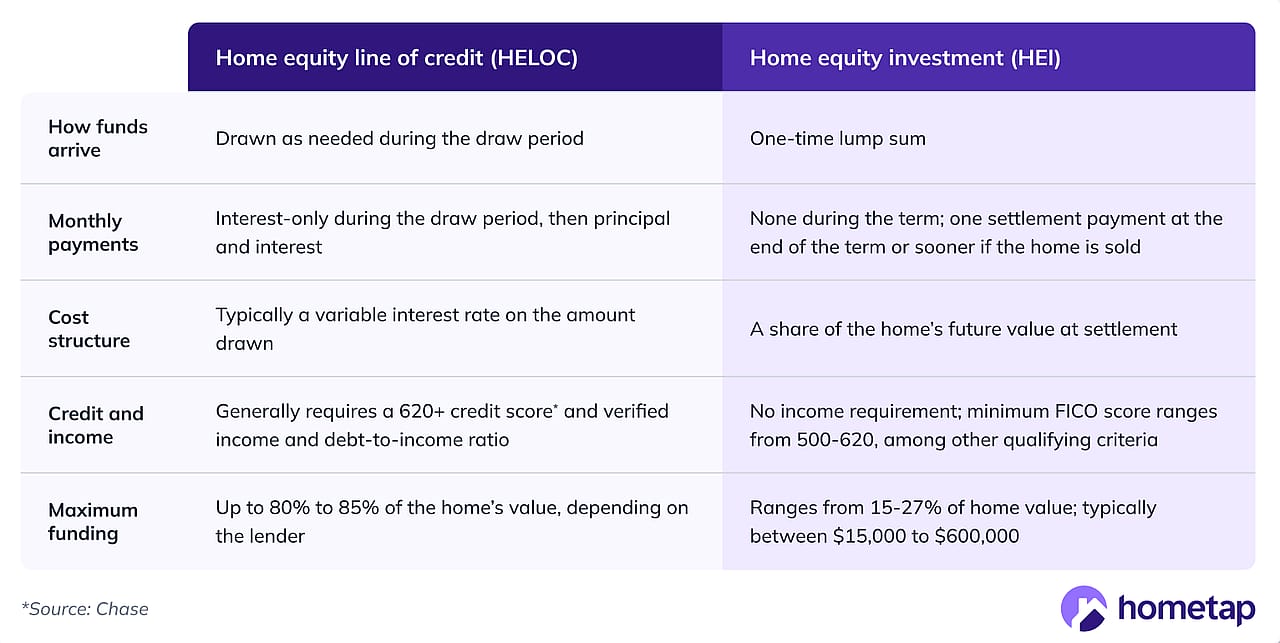
The Pros and Cons of a HELOC
Pros
- Offers flexibility to draw only what you need, when you need it
- Charges interest only on the amount drawn, not the full credit limit
- Can serve as a standing safety net for unpredictable expenses
- Often provides access to a larger share of home equity, commonly 80% to 85%
Cons
- Variable rates mean fluctuating monthly payments
- Monthly payments begin as soon as funds are drawn
- Qualification and approval typically depend on verified income and debt-to-income requirements
- Some lenders require a minimum draw, so a homeowner may take out more than needed
- A line of credit can be frozen if your credit score drops
The Pros and Cons of a Home Equity Investment
Pros
- No monthly payments during the term
- No impact to mortgage rate
- No income requirements, which may help homeowners with nontraditional income
- Provides a lump sum that could make sense for fixed-cost expenses, such as a renovation with a set budget
- No penalty for settling early
Cons
- Settlement cost depends on when the homeowner settles and the home’s value at that time
- Caps access at 27% of the home’s value, a smaller share than many HELOCs allow
- Isn’t available in every state or for every property type
Costs and Eligibility
Every option for accessing home equity has a cost and qualification criteria, and home equity investments are no exception. For most home equity investments, that includes:
- Fees: Closing costs and fees are deducted from the initial investment amount and can vary by state.
- Credit: The minimum FICO score ranges from 500-620 depending on the provider.
- Settlement: Homeowners can settle through a cash buyout, a refinance, a home equity loan or a home sale — any time within the term.
- Property types: Primary residences may be eligible. Vacation homes and rental properties could also be eligible, subject to additional criteria.
Questions to Consider Before Choosing
The better fit depends on a homeowner’s goals, timeline and comfort with monthly payments versus sharing a percentage of the home’s future value. A financial advisor can help weigh those factors.
Homeowners might ask themselves:
- Do I want ongoing access to funds or a single lump sum? A HELOC offers the former, and a home equity investment the latter.
- How do I feel about a new monthly obligation? A HELOC adds one. A home equity investment doesn’t, but it does involve a larger settlement payment later.
- How much of my home’s future appreciation/value do I want to keep? A HELOC leaves all of it with the homeowner so long as the balance of the drawn line of credit is paid back at the time the home is sold or refinanced. A home equity investment shares a portion.
- How will I settle? A home equity investment is typically settled through the proceeds of a home sale, refinance, loan, or buyout with savings, within the term.
This story was produced by Hometap and reviewed and distributed by Stacker.


